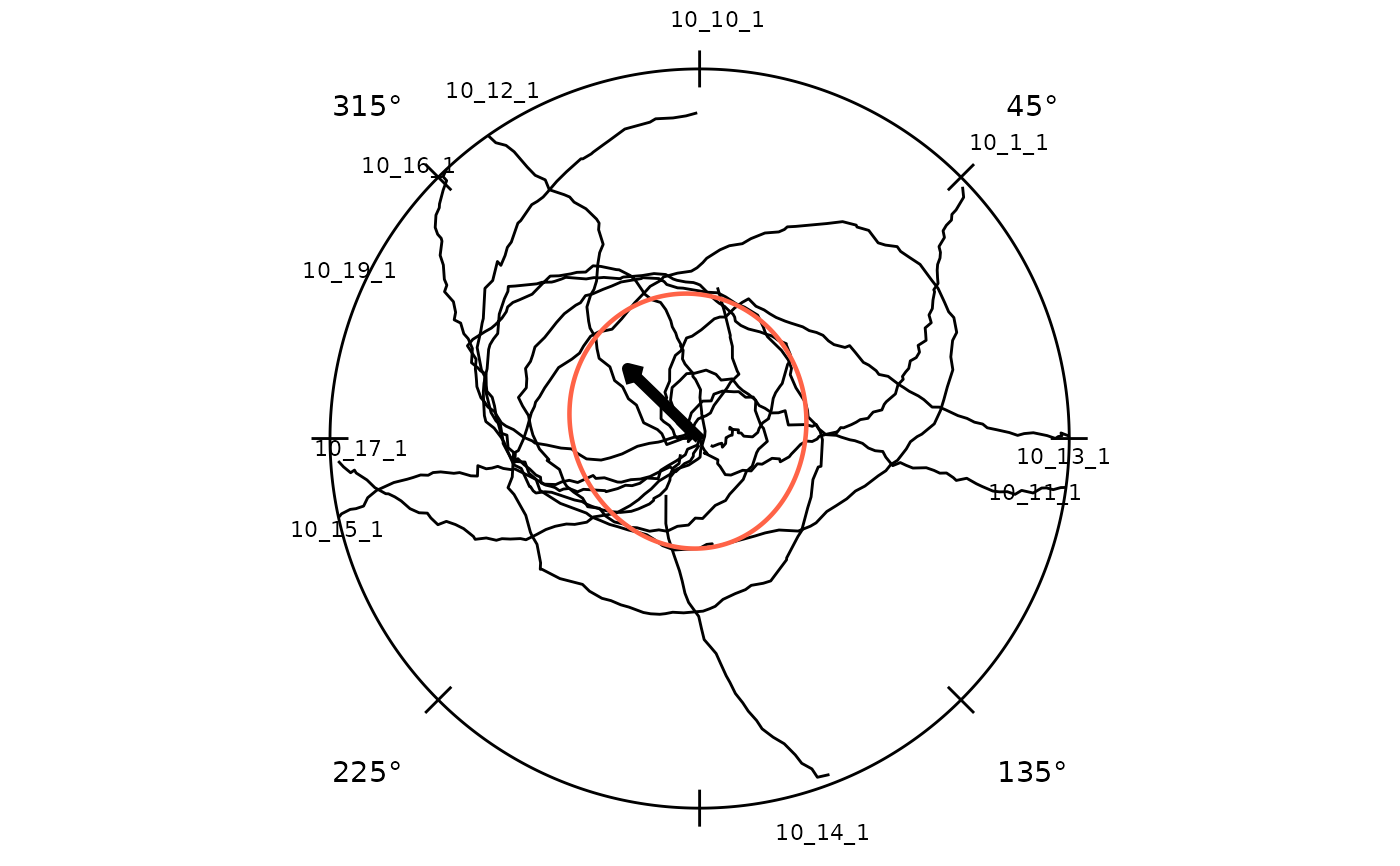
Overlay a non-parametric circular kernel density estimate on a radiate plot
Source:R/circular_plotting.R
add_circular_kde.RdEstimates the circular density using density.circular
(no distributional assumptions) and draws it as a closed polygon in the same
Cartesian coordinate space used by radiate and
add_angle_rose. Unlike add_vonmises_density,
this makes no assumption about the shape of the distribution and handles
multimodal data naturally.
Usage
add_circular_kde(
  hd,
  angle_col = "heading",
  group_col = NULL,
  bw = NULL,
  scale = 0.4,
  inner_r = 0,
  n_pts = 512L,
  kernel = "vonmises",
  colour = "tomato",
  linewidth = 0.8,
  fill = NA,
  alpha = 0.8,
  display = NULL,
  axial = FALSE,
  color = NULL
)
Arguments
- hd
Data frame with a heading column in radians.
- angle_col
Column name. Default
"heading".- group_col
Column for faceting; must match
facetsin the parentradiate()call.- bw
Bandwidth (concentration).
NULLusesbw.nrd.circularautomatic selection.- scale
Maximum outer radius as a fraction of the unit circle. Default
0.4.- inner_r
Inner radius. Default
0.- n_pts
Number of evaluation points. Default
512L.- kernel
Kernel name passed to
density.circular. Default"vonmises"(the kernel shape, not a model assumption).- colour, color
Outline colour. Default
"tomato".coloris the American-spelling alias.- linewidth
Outline width. Default
0.8.- fill
Fill colour. Default
NA(outline only).- alpha
Opacity. Default
0.8.- display
A `circ_display()` controlling rotation, matching the parent `radiate()` plot. Default `NULL` uses the input's `display` attribute when present, otherwise the identity display.
- axial
Logical; when `TRUE`, mirror each observation to `angle_col + pi` before estimation, yielding a period-pi (bidirectional) result. Default `FALSE`.
Details
The bw parameter is a concentration parameter (analogous to
\(\kappa\) of the von Mises kernel) – larger values produce a sharper,
data-following estimate; smaller values over-smooth towards uniform.
NULL (default) selects bandwidth automatically via
bw.nrd.circular.
Examples
hd <- derive_headings(cpunctatus[1:10], rule = "distal")
radiate(cpunctatus[1:10]) + add_circular_kde(hd)
#> Warning: Removed 5 rows containing missing values or values outside the scale range
#> (`geom_path()`).