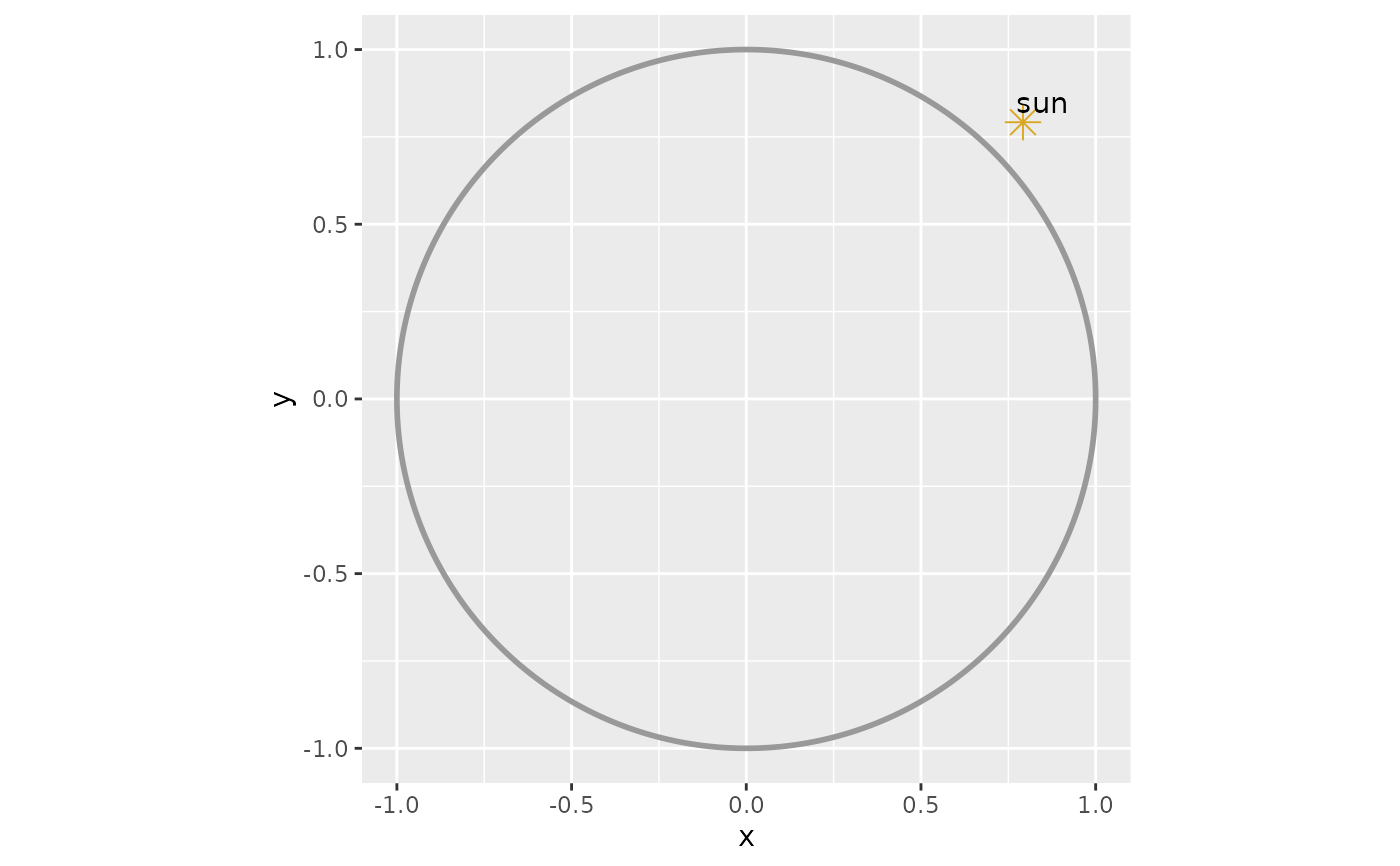
Draws a styled point just outside the rim at `bearing`, with a sun-like default (a gold asterisk), plus an optional text label. Change `shape`, `colour`/`fill` and `label` to mark any landmark (nest, feeder, light source). The bearing is given in **display units** (the value read off the axis), so the marker lands at the labelled position under any [circ_display()] convention.
Usage
add_landmark(
  bearing = 0,
  r = 1.12,
  shape = 8,
  size = 4,
  colour = "goldenrod",
  fill = "gold",
  label = NULL,
  display = circ_display(),
  ...,
  color = NULL
)
Arguments
- bearing
Direction of the landmark, in display units (degrees by default). Default `0`.
- r
Radius at which to draw the point. Default `1.12` (just outside the unit circle).
- shape
Point shape. Default `8` (asterisk, sun-ray-like).
- size
Point size. Default `4`.
- colour, color
Point colour. Default `"goldenrod"`. `color` is the American-spelling alias.
- fill
Fill colour, used only by fillable shapes (21–25). Default `"gold"`.
- label
Optional text label, drawn just beyond the point. `NULL` (default) draws no label.
- display
A [circ_display()] giving the plot's angle convention. Default `circ_display()`. Pass the same value used in [radiate()].
- ...
Further arguments passed to [ggplot2::geom_point()].
Value
A list of ggplot layers: a `geom_point()` layer, plus a `geom_text()` layer when `label` is supplied.
American spellings
Every `colour...` argument and the `assign_colour_*` / `cycle_colours` / `hf_colour_col` functions accept the American `color...` spelling as an alias (e.g. `color`, `color_col`, `track_color`). British spelling is canonical; supplying both spellings of a pair is an error.
Examples
library(ggplot2)
ggplot() + coord_fixed() + add_circ() +
  add_landmark(bearing = 45, label = "sun")